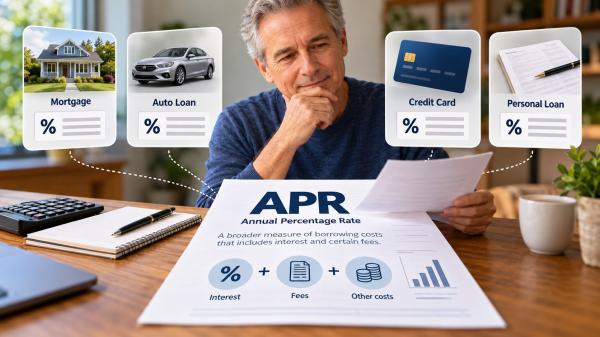
When you borrow money, the interest rate is not the only cost to consider. Fees and other borrowing costs can affect how much you pay over time. That is why lenders disclose the Annual Percentage Rate, commonly called APR.
APR helps borrowers compare the cost of loans and credit products. Understanding this figure can make it easier to evaluate personal loans, auto loans, mortgages, and credit cards.
But APR does not tell the whole story. Loan terms, monthly payments, fees, and repayment periods also matter when comparing borrowing options.
What Does APR Mean?
APR stands for Annual Percentage Rate. It expresses the annual cost of borrowing money as a percentage.
APR generally reflects the interest rate plus certain fees associated with obtaining credit. The fees included depend on the type of loan and applicable disclosure rules.
For example, a personal loan may have an interest rate and an origination fee. The origination fee is a charge for processing or arranging the loan. When applicable, this fee affects the loan’s APR.
A mortgage APR may include the interest rate, discount points, mortgage broker fees, and other qualifying charges.
APR gives borrowers a broader picture of borrowing costs than the interest rate alone. It is also a standard disclosure that helps consumers compare credit offers.
The Consumer Financial Protection Bureau (CFPB) explains that APR is a broader measure of borrowing costs than the interest rate. Source: CFPB
What Is the Difference Between APR and Interest Rate?
The interest rate measures the cost of borrowing the principal amount. The principal is the original amount borrowed, before interest and other charges.
APR includes the interest rate and certain additional borrowing costs. Because of these added costs, a loan’s APR is often higher than its interest rate.
Consider a hypothetical example.
Suppose two lenders offer personal loans with the same interest rate. One lender charges an origination fee, while the other does not charge that fee.
The loans may have different APRs because their costs differ. Comparing APRs can help reveal this difference.
However, the APR alone does not establish which loan is better. The repayment term, payment schedule, other fees, and total amount repaid also matter.
APR vs. Interest Rate at a Glance
| Feature | Interest Rate | APR |
| What it measures | Cost of borrowing the principal | Broader annual measure of borrowing costs |
| Includes interest | Yes | Yes |
| Accounts for certain fees | No, not by itself | Generally, where required by applicable rules |
| Useful for comparing loans | Yes, as one factor | Yes, as a broader comparison measure |
When reviewing loan offers, compare APR with APR rather than comparing one lender’s APR with another lender’s interest rate.
Why Does APR Matter When Borrowing Money?
APR matters because it helps you understand the cost of credit before agreeing to borrow.
Here are three reasons to pay attention to it.
1. It Helps You Compare Loan Offers
Two lenders may offer the same loan amount but charge different interest rates or fees. APR helps account for these differences.
For example, a loan with a lower interest rate may include higher fees. Another loan may have a slightly higher interest rate but lower fees.
Looking at APR alongside the other loan terms can help you make a more meaningful comparison.
2. It Helps You Understand Borrowing Costs
A monthly payment does not show the full cost of a loan.
A longer repayment period may reduce the monthly payment but increase the total interest paid. Fees can also increase the overall cost of borrowing.
APR provides useful information, but you should also review the total amount you will repay over the loan’s life.
3. It Helps You Review Credit Offers More Carefully
In the United States, federal lending disclosure rules require APR information for many consumer credit products.
These disclosures help borrowers understand important terms before committing to credit.
Before accepting an offer, review the APR, interest rate, fees, repayment schedule, and any conditions that could change the cost.
How Does APR Work for Different Types of Credit?
APR is relevant to several common borrowing products. However, the way it is calculated and applied can differ.
Personal Loans
Personal loans may have fixed monthly payments over an agreed repayment period.
Depending on the loan, APR may include interest and an origination fee. Comparing APRs can help you evaluate offers from different lenders.
You should also compare the loan term and total repayment amount. A longer term can lower the monthly payment while increasing the total cost.
Auto Loans
When financing a vehicle, APR helps you compare credit offers from lenders or dealerships.
The loan amount, interest rate, fees, and repayment period can affect the overall cost.
Before signing, review the written financing disclosures. In addition to APR, check the amount financed, finance charge, number of payments, and total of payments.
These figures can help you understand the full financial commitment.
Source: CFPB — Auto Loan Disclosures
Mortgages
Mortgage APR generally includes the interest rate and certain additional charges associated with obtaining the loan.
These charges may include discount points and mortgage broker fees. As a result, the mortgage APR is usually higher than the stated interest rate.
When comparing mortgage offers, review the Loan Estimate provided by each lender. Pay attention to the interest rate, APR, estimated closing costs, and repayment terms.
Be especially careful when comparing fixed-rate mortgages with adjustable-rate mortgages. An adjustable rate can change over time, and its APR does not necessarily reflect the maximum interest rate the borrower could face.
Source: CFPB — Mortgage Interest Rate vs. APR
Credit Cards
Credit card APR represents the annual interest rate used to calculate interest on applicable balances.
Unlike many installment loans, credit cards allow borrowers to reuse available credit as they repay their balances.
A credit card may have different APRs for purchases, cash advances, and balance transfers. Promotional APRs may also apply for a limited period.
Many credit cards offer a grace period on purchases. If the card provides one and you pay the statement balance in full by the due date, you can generally avoid interest on purchases.
However, cash advances and balance transfers may have different terms. Read the cardholder agreement to understand the applicable rates, fees, and payment requirements.
Source: CFPB — Credit Card APR Terms
Is a Lower APR Always Better?
A lower APR can indicate a lower borrowing cost, but it does not automatically make a loan the better choice.
The full terms of each offer matter.
Consider these factors when comparing loans:
- Repayment term: How many months or years will you make payments?
- Monthly payment: Does the payment fit your budget?
- Total repayment: How much will you pay over the entire loan term?
- Fees: Are there origination fees, closing costs, or other charges?
- Rate structure: Is the rate fixed or variable?
- Prepayment terms: Can you repay the loan early without a penalty?
For example, two loans may have similar APRs but different repayment periods. The loan with the longer term may have a lower monthly payment, yet cost more in total.
Comparisons also become less straightforward when the loans have different features. A fixed-rate loan and a variable-rate loan may not expose borrowers to the same risks.
APR is a useful starting point, not a substitute for reviewing the complete agreement.
What Should You Check Before Accepting a Loan?
Before agreeing to borrow, take time to review the offer in writing.
Use this checklist to organize your comparison:
- Confirm the APR and interest rate.
- Review all disclosed fees and charges.
- Check the repayment term and number of payments.
- Calculate or verify the total amount you will repay.
- Confirm whether the interest rate is fixed or variable.
- Read the terms for late payments and early repayment.
- Check whether promotional rates expire or change.
- Compare offers with similar loan amounts and repayment terms.
You can also ask the lender to explain any fee or condition you do not understand.
For auto loans, the Federal Trade Commission recommends comparing financing terms and asking questions before signing. Its car financing guide explains how direct lending and dealership financing work.
Common Questions About APR
Can APR Be Higher Than the Interest Rate?
Yes. APR often exceeds the interest rate when certain fees and charges are included in its calculation.
The difference depends on the loan structure, applicable fees, repayment schedule, and relevant disclosure rules.
Does APR Affect My Monthly Payment?
APR reflects borrowing costs, but the monthly payment also depends on the amount borrowed, repayment term, and payment structure.
A loan with a lower APR may still have a higher monthly payment if it has a shorter repayment period or a larger principal balance.
Is Credit Card APR the Same as Loan APR?
Both express borrowing costs as an annual percentage, but their application can differ.
Credit cards may have separate APRs for purchases, cash advances, and balance transfers. Installment loans generally have a defined repayment schedule.
Always review the terms specific to the credit product.
Can APR Change Over Time?
Yes, depending on the product and agreement.
A fixed APR generally does not fluctuate with changes in an index. A variable APR can change according to the terms of the agreement and the applicable index.
Promotional rates may also change when the introductory period ends. Review the agreement to understand when and how the rate can change.
Source: CFPB — Fixed APR vs. Variable APR
Bottom Line
APR is an important tool for understanding the cost of borrowing money. It accounts for the interest rate and certain additional charges, making it useful when comparing loan and credit offers.
However, APR does not tell the entire story. Repayment terms, fees, monthly payments, total repayment, and potential rate changes also deserve attention.
Before accepting a loan, compare offers with similar terms and read the full agreement. Understanding APR can help you evaluate borrowing costs more clearly and make decisions based on the complete financial picture.
This article provides general information and is not individualized financial, tax, or legal advice.
Sources
- Consumer Financial Protection Bureau: Loan Interest Rate vs. APR
- Consumer Financial Protection Bureau: Mortgage Interest Rate vs. APR
- Consumer Financial Protection Bureau: Auto Loan Disclosures
- Consumer Financial Protection Bureau: Credit Card APR Terms
- Consumer Financial Protection Bureau: Fixed APR vs. Variable APR
- Federal Trade Commission: Financing or Leasing a Car
- What Does APR Mean?
- What Is the Difference Between APR and Interest Rate?
- APR vs. Interest Rate at a Glance
- Why Does APR Matter When Borrowing Money?
- 1. It Helps You Compare Loan Offers
- 2. It Helps You Understand Borrowing Costs
- 3. It Helps You Review Credit Offers More Carefully
- How Does APR Work for Different Types of Credit?
- Personal Loans
- Auto Loans
- Source: CFPB — Auto Loan Disclosures
- Mortgages
- Source: CFPB — Mortgage Interest Rate vs. APR
- Credit Cards
- Source: CFPB — Credit Card APR Terms
- Is a Lower APR Always Better?
- What Should You Check Before Accepting a Loan?
- Common Questions About APR
- Can APR Be Higher Than the Interest Rate?
- Does APR Affect My Monthly Payment?
- Is Credit Card APR the Same as Loan APR?
- Can APR Change Over Time?
- Source: CFPB — Fixed APR vs. Variable APR
- Bottom Line
- Sources